


Visit Bogan Shire Booklet
Click here to view the Visit Bogan Shire Booklet.
Regional Platter

Regional Platters is an agricultural trail guide designed to connect producers in the central west with a range of markets including the group visitor market, investors and special interest groups.
Flip through the guide, explore the products and plan your group’s visit to the region by contacting the producers directly or liaising with a tour operator.
Contents
- About this guide
- Welcome
- About the region
- Dubbo producers
- Gilgandra producers
- Mudgee producers
- Narromine producers
- Nyngan producers
- Warren producers
- Warrumbungles producers
- Wellington producers
- Tour operators
- Events
- Visitor information centre contacts
When viewing the FlipBook below, be sure to click the fullscreen button down the bottom right hand side for easy to read viewing.
* PLEASE NOTE: the flipbook below may take several seconds to load.
Helicopter
 Iroquois 1022 was donated to the town of Nyngan by the Federal Government to commemorate the evacuation of residents during the tragic 1990 Flood. Helicopters were used to airlift stricken residents out of the town and few would dispute the Iroquois' appropriateness as a symbol of courage.
Delivered from the United States in 1962, 1022 played a vital role in the Vietnam War transporting Australian troops and equipment. In May 2011 Iroquois 1022 was transported by volunteers to Caloundra in Queensland where the helicopter was fully restored and placed on display at the Caloundra RSL. A restored replacement Iroquois A2-022 was delivered to Nyngan and is now mounted on a pole in Vanges Park, Pangee Street
Macquarie Marshes
The Macquarie Marshes are an extensive wetland system covering an area of 220,000 hectares in north-west New South Wales, representing one of the largest semi-permanent wetlands in south-eastern Australia.
Commencing in the south at Marebone Weir, which is situated 50kms north of Warren, they extend to the north a further 100kms until all the channels unite to form one near Carinda.
The Northern Marshes provide a scenic landscape of Common Reed (Phragmites Australia's) and River Red Gum (Eucalyptus camaldulenis).The Macquarie Marshes are a well known habitat of many waterbirds. Over 60 species have been sighted here with a reported 42 of the species using the ideal conditions for a breeding place. Ibis, Egrets, Cormorants, Spoonbills and Herons are but a few of the breeding species found at the Macquarie Marshes.
There are also many different varieties of aquatic plants growing freely in this wonderful natural wetland.
The Fauna also presents a rich variety of animals, including several of the mammal species.
River
The Bogan River
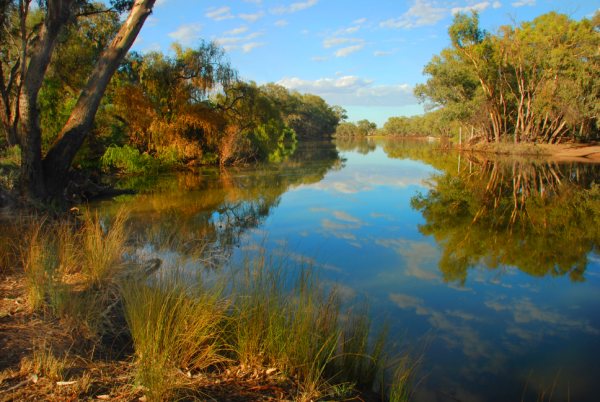
The Bogan River was discovered by Charles Sturt in 1829 and is a minor river in the central western region of New South Wales, Australia. The Bogan starts near Forbes and flows generally north-north-west past Nyngan. Unlike the other main rivers of inland New South Wales, the Bogan does not rise in the well-watered highland areas, so its flow is low and erratic and not much use for irrigation. The Bogan is a tributary of the Darling River. Major Sir Thomas Mitchell reached it in 1835.
Public Notices
-
April 23, 2026
Development Application – Public Exhibition
NOTICE is hereby given that a Development Application has been submitted to Bogan Shire Council for Multi-Dwelling Housing. The proposed development is located at Lot B D.P. 396446 No. 13 Minore Street Nyngan NSW 2825. The proposed site plan and relevant… -
April 21, 2026
BOGAN SHIRE- ANZAC DAY 2026
The Nyngan sub-Branch of the Returned and Services League will be holding the following ceremonies on Anzac Day: 6am – Dawn Service. This will be held at the Cenotaph in front of the Bogan Shire Council (81 Cobar Street, Nyngan). Attendees are requested to… -
April 16, 2026
NYNGAN SHOW DAY 2026 – PUBLIC HOLIDAY NOTICE
Council would like to advise that the Nyngan Show Day will be a half day local public holiday on Monday May 18 2026 for the Bogan Shire Local Government Area. The local public holiday will commence from 12 noon onward and will allow members of the community… -
April 16, 2026
COUNCIL COLUMN 16 APRIL 2026
DISABILITY INCLUSION ACTION PLANNING COMMUNITY SURVEY Council is currently conducting a community survey on how to improve the accessibility of its services, facilities, and activities. If you are someone with a disability or a carer, family member, friend of… -
Mar 26, 2026
COUNCIL COLUMN 26 MARCH 2026
352NYNGAN CENOTAPH Restoration works are currently underway at the Nyngan Cenotaph. Council… -
Mar 12, 2026
COUNCIL COLUMN 12 MARCH 2026
544BOGAN SHIRE SENIORS WEEK 15-20 MARCH Sunday 15 March: Free concert at the Nyngan Bowling… -
Mar 05, 2026
Mayors Column 5 March 2026
818We are desperately in need of heavy rain, with the rest of the country getting record… -
Feb 26, 2026
COUNCIL COLUMN 26 FEBRUARY 2026
850NEW RESIDENTIAL SUBDIVISION – SALE OF LOTS Expressions of Interest for the first eight…
What's On
-
 April 02, 2026
BOGAN SHIRE LIBRARY- APRIL 2026
At Bogan Shire Library will continue all your favourite programs including weekly Story Times and Baby Time in April. POP-UP LIBRARY - 20 April to 22 May. Bogan Shire Library will soon undergo renovations as part of the third phase of our library improvement… -
 March 30, 2026
BOGAN SHIRE YOUTH AND COMMUNITY CENTRE - April 2026
BOGAN SHIRE YOUTH AND COMMUNITY CENTRE The Bogan Shire Youth and Community Centre has a full month of activities lined up for April for youth aged 12–24. Drop in weekdays from 3–6pm, school holidays, Youth week- get involved in a mix of sports, games,… -
 February 26, 2026
Bogan Shire Council – Seniors Week 2026!
Bogan Shire Council is proud to present Seniors Week 2026, celebrating the valued contributions of seniors within our community. This year’s program features a range of events across the Shire, including live entertainment by Keith Podger, original band…
Careers
-
January 06, 2026
Expression of Interest/Notification of Availability for Employment
Bogan Shire Council welcomes Expressions of Interest from motivated people who want to contribute to a safe, inclusive, and community‑focused workplace. Submitting an EOI does not guarantee employment, and you may be directed to apply through our formal…